Alternative splicing · Protein isoforms · ALS

One gene,
many proteins.

Most genes produce multiple protein isoforms with distinct functions. We study what these isoforms do, how their misregulation drives neurodegeneration and cancer, and how they could be selectively targeted. Our major focus is ALS, where we ask how disrupted RNA processing leaves motor neurons vulnerable.

Who we are

From RNA mechanism to disease biology.


The Weatheritt Lab is a multidisciplinary RNA biology group at the Garvan Institute of Medical Research and UNSW Sydney, and part of EMBL Australia.

Our work asks how cells expand biological function beyond the information encoded in genes. We focus on alternative RNA processing, protein isoforms and biomolecular condensates, and we build computational and long-read methods to measure them at the level of whole transcripts and single cells.

Motor neuron disease is a major focus of the lab. We apply these isoform-level approaches to ALS, asking how disrupted RNA processing changes the protein landscape of vulnerable neurons and where it might be corrected.

Research program

The molecular logic of RNA in health and disease.

We connect transcript-level changes to protein behaviour and cellular phenotype, combining discovery-scale approaches with focused mechanistic experiments.

Immunofluorescence image of a stem cell-derived neuron expressing dCas9, with branching neurites
ALS and motor neuron disease

Why do motor neurons fail?

We use long-read sequencing of patient stem cell-derived motor neurons, including SOD1-ALS and TDP-43 models, to ask how disrupted splicing, polyadenylation and cryptic exons change the proteins vulnerable neurons make, and why ALS differs between men and women. We pair this with drug screens to search for compounds that selectively correct disease-associated isoforms.
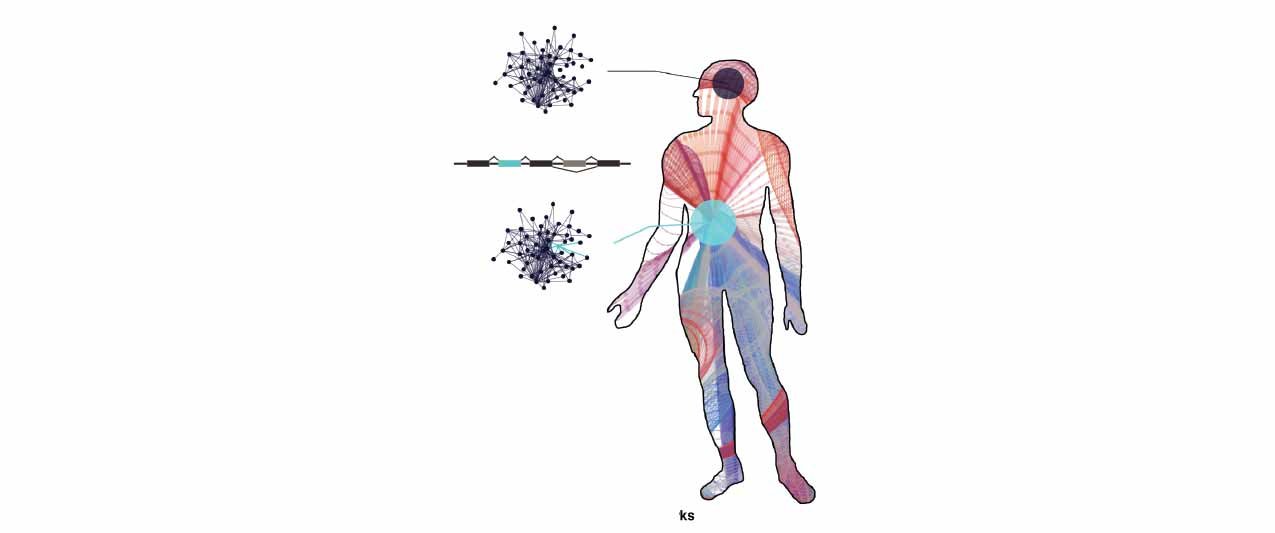
Illustration of tissue-specific protein interaction networks produced by alternative isoforms
Isoform function

What does each isoform do?

Most human genes make several protein isoforms. We map how alternative exons and promoters rewire protein interactions and localisation, and how isoform-specific therapies could exploit those differences.

Single-cell functional genomics

Testing isoform function, one cell at a time.

We combine CRISPR perturbation with single-cell and long-read sequencing to test what individual isoforms and alternative promoters do, including how they shape cancer cell responses to drugs, and to resolve allele-specific expression such as X chromosome inactivation.

Fluorescence microscopy of a cell showing cytoplasmic RNA condensates in magenta and green
RNA compartments

Cells organise RNA without membranes.

We profile what P-bodies and stress granules hold and how their contents shift under stress, including the accumulation of oncogenic mRNAs, linking RNA compartments to translation, cancer and the stress granule pathology seen in ALS.

How we work

Integrated by design.

The questions determine the method. Our program joins quantitative discovery with experiments that resolve function at isoform and single-cell level.

Computational biology
Transcriptomics and long reads
Proteomics and interaction networks
CRISPR perturbation screens
High-content imaging

Selected publications

Recent and defining work.

2026
Lineage-specific X chromosome inactivation escape and skew underlie sex-biased immune gene dosage and deleterious variant exposureKavanagh D, et al.
bioRxiv
2026
Alternative splicing fine-tunes modular protein interfaces to control protein localisationKjer-Hansen P, et al.
Nature Structural & Molecular Biology
Robert Weatheritt

Lab head

Associate Professor Robert Weatheritt

EMBL Australia Group Leader, Viertel Senior Medical Research Fellow, and ARC Future Fellow.

Robert trained in computational biology and neuroscience before completing his doctorate at EMBL and Heidelberg University. His postdoctoral work at the MRC Laboratory of Molecular Biology and the University of Toronto established a research program at the interface of RNA regulation, proteomics and cellular organisation. He founded the Weatheritt Lab in Sydney in 2018.

His work has helped show how alternative splicing rewires protein interaction networks and higher-order assemblies, including work defining a conserved program of neuronal microexons and the development of Whippet for fast splicing analysis. The lab now aims to move from cataloguing RNA variation to explaining what individual isoforms do.

  • 2025–2028 Two ARC Discovery Project grants
  • 2024–2027 NHMRC Ideas Grant
  • 2023–2028 Sylvia and Charles Viertel Senior Medical Research Fellowship
  • 2022–2025 NSW Health RNA Future Leaders Grant
  • 2022–2025 ARC Future Fellowship

People

Computational and wet-lab scientists, working side by side.

Former members

  • Yohaann Mohamed Asif JafraniPostdoc, 2024–2026
  • Helen KingPhD student, 2021–2025Now Postdoc, King's College, University of Cambridge
  • Peter Kjer-HansenPhD student, 2020–2025Now Postdoc, University of Copenhagen
  • Javier FernandezPostdoc, 2019–2024Now Group Leader, Vow Foods
  • Gabriela Santos-RodriguezPhD student, 2019–2023Now Postdoc, UNSW Sydney
  • Brandon SyPostdoc, 2020–2022Now Grant Manager, UNSW Sydney
  • Nesli AvganPostdoc, 2018–2020Now CEO, SaluStory

Join and collaborate

Help us understand what RNA changes mean.

We welcome students and researchers who want to connect computational discovery with molecular and cellular mechanism.

PhD and Honours

Projects span RNA processing and drug screening in patient stem cell-derived motor neurons, long-read and single-cell analysis, and isoform function in human cells. We particularly welcome applicants from neurodegeneration, neuroscience or stem cell backgrounds. Students enrol through UNSW Sydney.

Postdoctoral researchers

We are glad to discuss positions and to support fellowship applications in RNA biology, functional genomics and computational biology.

Getting in touch

Send a CV and a few lines on which question interests you and why. Collaborators are welcome to reach out directly.

Email Robert